
NODE 01
Passive Radar
Multistatic passive detection and thermal camera cueing — long wavelengths diffract around terrain and penetrate vegetation to eliminate low-altitude blind spots. The sensor emits nothing.
A passive, distributed detection mesh that turns existing streetlight infrastructure into a persistent low-altitude airspace sensor network.
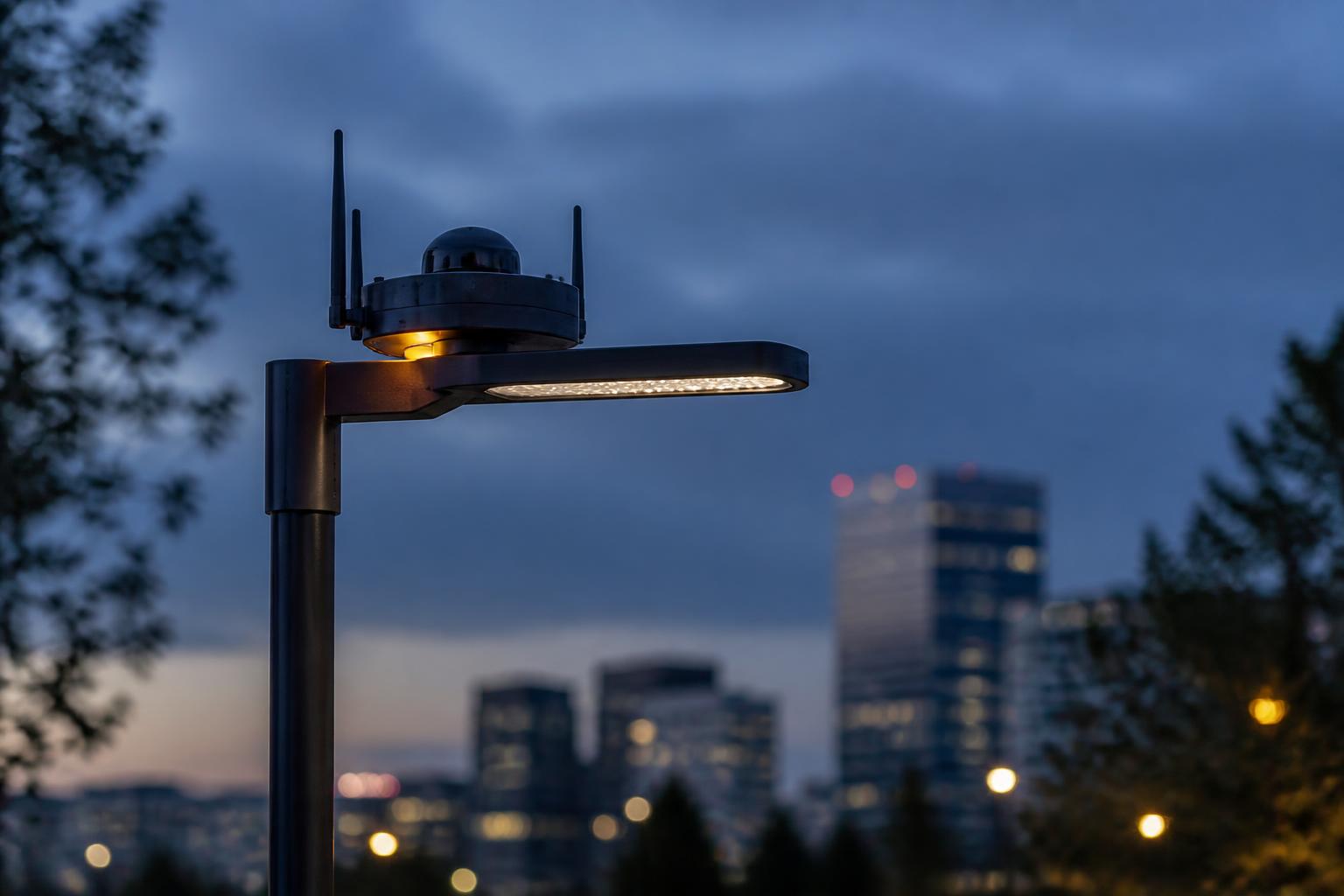
Standard installation onto existing streetlight sockets at 30' AGL — zero new towers, zero trenching, designed for lower siting cost than traditional tower installations.
Multi-modal detection stacked on every node — each sensor covers the gaps of the others, so nothing slips through.
Multistatic passive detection and thermal camera cueing — long wavelengths diffract around terrain and penetrate vegetation to eliminate low-altitude blind spots. The sensor emits nothing.
400 MHz – 8 GHz passive detection of RF emissions identifies drone make, model, and operator. No active emissions required.
Camera cued by RF detection confirms flagged targets through visual identification and continuous tracking.
MEMS acoustic sensor array detects drone motor signatures; effective against non-RF and RF-silent targets.
Each node is engineered for a detection range of 200 meters against Group 1–2 UAS as a design target, assuming urban multipath, ambient illuminators, a 30 ft AGL mount height, and thermal camera cueing. Range characterization is in progress.
Area coverage comes from the mesh in aggregate, not from any single node. Overlapping per-node footprints are designed to deliver continuous, redundant coverage across the corridor — so a track is maintained as a target moves between nodes.
Every node carries its own processing power, so detection, fusion, and classification happen where the data is collected — not in a distant cloud.
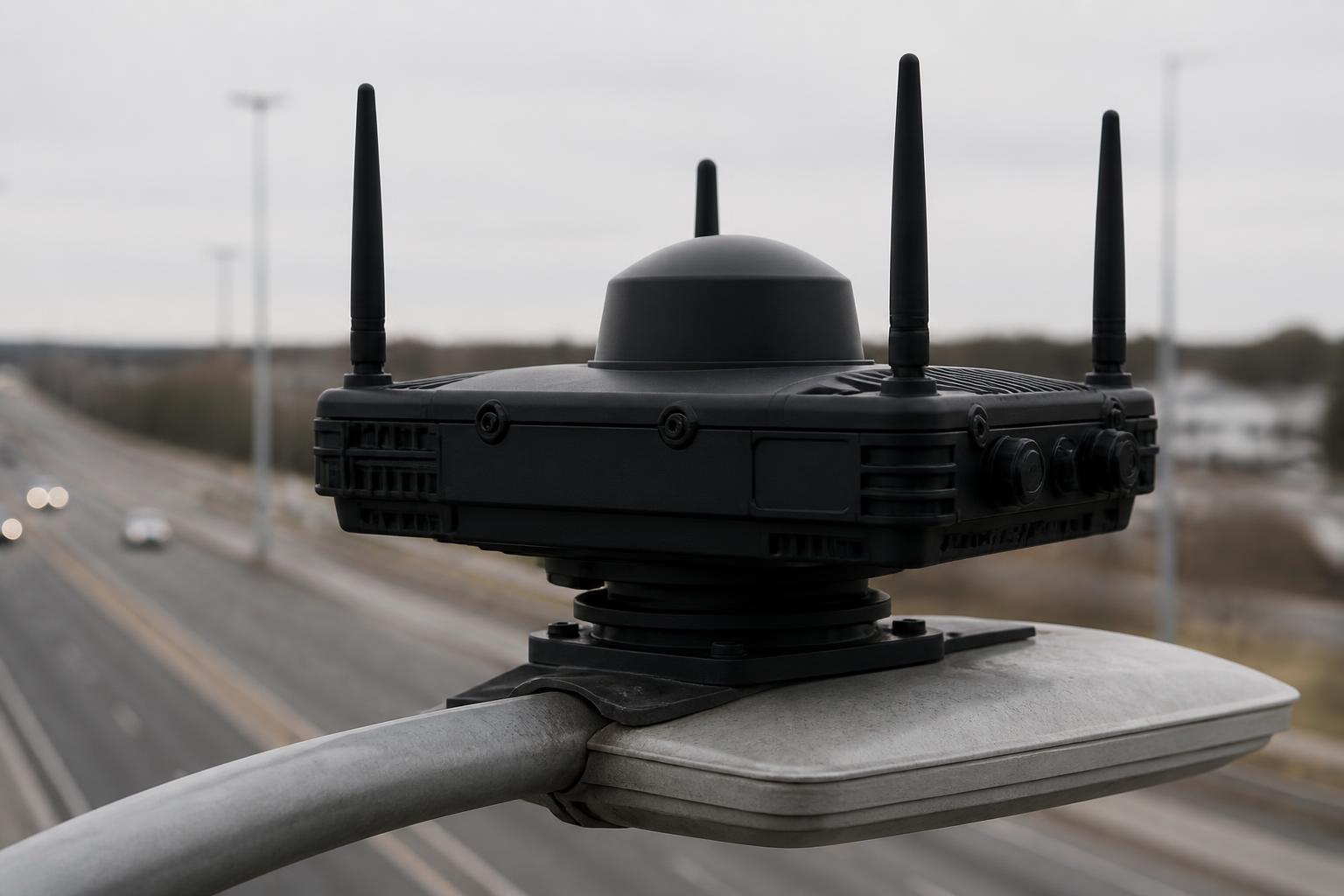
Passive-first sensing from streetlight height delivers advantages legacy tower systems cannot replicate.
Constant active emissions create a spectral beacon. Sensing is emission-free — multistatic passive detection and thermal imaging, invisible to adversary ELINT. Node networking runs separately over secure LTE/5G backhaul.
30' AGL mounting height removes radar 'dead zones' beneath the horizon of legacy tower sensors.
Engineered for sensitivity at ranges as close as 50 m where high-power radars may saturate.
Designed to detect low-observable and RF-silent threats through multistatic passive detection and thermal camera cueing — exploiting bistatic reflections from illuminators of opportunity rather than Doppler shift alone.
Three progressive filters turn raw sensor data into actionable tracks — wide discovery, kinematic validation, and visual confirmation.
Passive radar and broadband RF sensing (400 MHz – 8 GHz) detects threats without emissions.
Filtering at the GPU core based on flight profile to reject biological and ground clutter.
Automatically cue optical sensors for characterization and physical length estimation.
Get detailed sensor specs, deployment options, and integration architecture for your mission set.